




Battling the effects of the Great Resignation, the Great Reshuffle, Baby Boomer retirements, a wave of layoffs, and “quiet quitting,” insurers, like all businesses, are wrestling with how to grow revenue, keep expenses in line, delight increasingly-demanding customers, and attract and retain qualified and satisfied employees.
A tall order indeed.
And yet, carriers are sitting on a vast reservoir of under-utilized talent: their cadre of insurance underwriters.
The need to retain, excite and make underwriters more productive is a strategic imperative. With some estimates indicating that it takes 24 – 36 months for a new underwriter to reach full productivity, retaining and satisfying current underwriters takes on added importance.
In this blog post, we’ll look at what is keeping underwriters from fulfilling their full potential, how technology can help free them up for more productive tasks, and how insurers can reap significant benefits from setting them free.
Related: 6 Benefits of an Automated Underwriting System in Insurance
Insurance Underwriters: Bogged Down in Non-Productive Tasks
Amidst labor shortages and the never-ending quest for digital transformation, it’s telling - and quite distressing - that we see industry-savvy observers publishing articles with titles such as “Why Underwriters Don’t Underwrite Much”.
In that article, InsuranceThoughtLeadership.com reports that the average underwriter spends 40% of his/her time on administrative work, 30% on negotiation and sales support, and only 30% actually doing underwriting.
One could argue that the 30% spent on negotiation and sales support is productive, in that it helps drive business, and the 30% that’s actual underwriting is in fact the job they’ve been hired to do. But that other 40% that’s administrative work is ripe for digital transformation.
How Much Untapped Potential is There in Underwriting?
According to the US Bureau of Labor Statistics, there are 57,080 underwriters employed by insurance carriers in the US alone. (There are another 38,870 in brokerages and other insurance-related businesses, but we’ll focus only on those in the carrier space for now.)
Doing the math, based on a standard 40-hour work week and the 40% of underwriters’ time spent on administrative tasks, there are conservatively nearly 44 million administrative person-hours spent each year in carrier organizations nationwide. Anything we can do with technology to improve the situation will pay big dividends.
Productivity Is Just the Beginning
Wasted time is not the only recoverable asset here. The other 60% of insurance underwriters’ time can also be made more precise and more productive, and better serve insurers’ business goals.
Deloitte has posited that underwriting professionals need to evolve to become “exponential underwriters,” and that armed with the right tools, underwriters can move from hindsight to foresight, apply more science in support of the human-driven art of the function, and incorporate new inputs, risks, and flexibility into underwriting decisions.
Carriers can reap benefits that include better and more accurate pricing and rating, better risk management across the portfolio, and higher customer satisfaction.
Underwriters are Ready to Be Set Free
The good news is that underwriters are anxious to play a more substantive role in the business, and have not given up on being more engaged and excited about their work.
In the P&C Underwriting Survey cited earlier, underwriters listed four key areas in which they would welcome increasing involvement:
The development of new products and services;
Process automation and the use of AI for improving underwriting performance;
New data sources; and,
All of these are topics that also involve and excite other team members within carrier organizations, so drawing insurance underwriters and underwriting leadership into these discussions and initiatives should be a natural extension of programs designed to automate and upgrade insurance processes end-to-end.
Underwriting: the “Final Frontier” of Insurance Transformation
Much of insurers’ attention in advancing their technology profiles has been focused on the “front office” tasks around delivering an industry-leading customer experience (CX), including implementation of data analytics in the quest to more accurately price products, personalize offers, and manage risk in a world of growing uncertainty. Certainly the logical place to start.
Their investments have focused on functions with high customer visibility, such as sales, marketing, pricing, rating, account servicing, and claims management, all key elements of the insurance value chain.
As a result, those other functions are ahead of underwriting in the digital transition to an era of Intelligent Insurance Operations, or Intelligent InsurOps, and insurers are increasingly aware that this lag is affecting their business success.
Current Underwriting Processes Are Broken
In many ways, underwriting is the beating heart of the insurance business, even if it’s not highly visible to the outside world. Unfortunately, that beating heart is not as healthy as it could be.
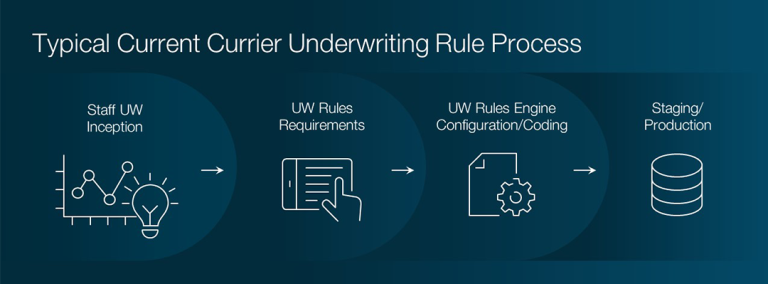
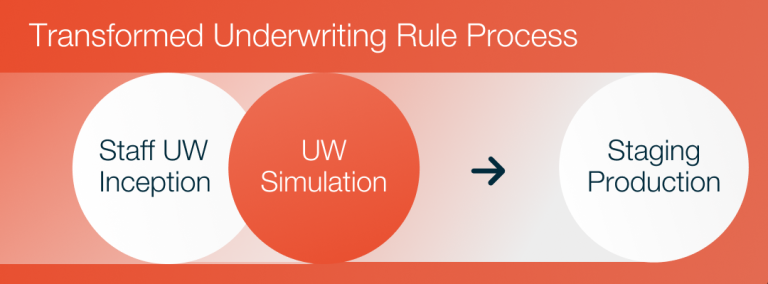
The way that underwriting rules are developed and deployed today is a major culprit in limiting the function’s speed and effectiveness, and it ties up underwriters in that repetitive and unproductive work we highlighted earlier.
In pre-transformation insurers, the process of implementing a new underwriting rule typically looks like this: