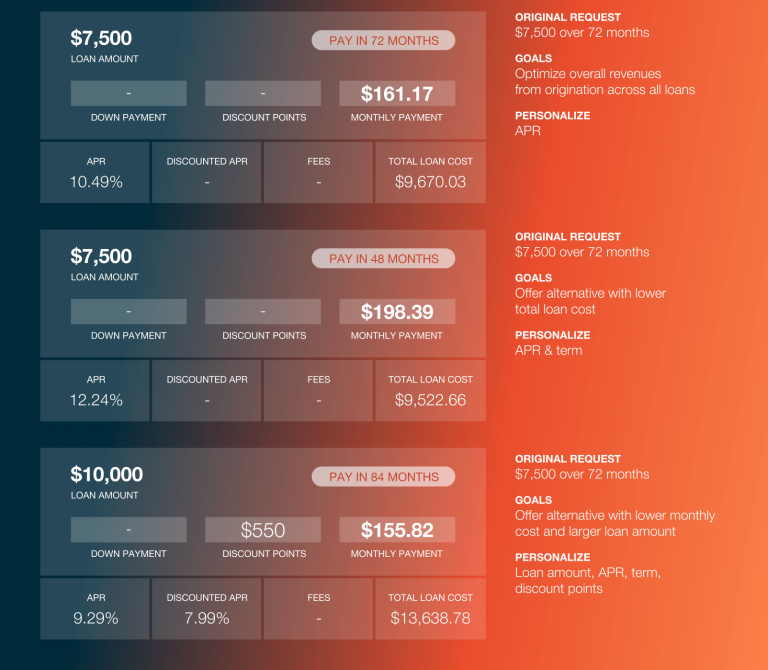
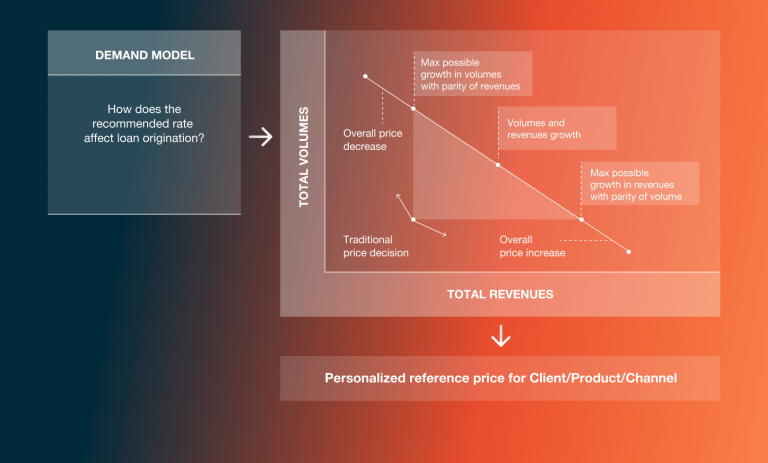
In a traditional pricing decision, every consumer is offered the same generic loan package. While this is easy to accomplish, and is the current norm for many lenders, it is suboptimal.
With loan personalization, the lender can “throttle” the terms of the loan offer to each applicant, and vary the parameters with multiple adjustments, increasing the likelihood of offer acceptance. At the same time, that “throttling” allows the lender to make trade offs between growth in origination volume and revenue.
This optimization process leads to that “win-win” situation – consumers get the loan that works best for them, and lenders can optimize their outcomes to meet their strategic business objectives and KPIs.
How to Get Started with Loan Personalization: The Four Pillars of Loan Personalization
1. Digital Delivery
As mentioned earlier, loan applicants, particularly younger ones, are primed to engage directly with lenders who digitally deliver personalized loan offers. Having “grown up digital,” and in an instant gratification world, these consumers prefer to research, compare, apply for, and close loans online.
Loan terms, conditions and alternatives must all be made available for their consideration in real time, with the underwriting process automated and instantaneous as well.
Sometimes overlooked is that digital delivery is also important in the branch setting. Enabling bank advisors with instantaneous digital access to personalized offers will also improve close rates and increase loan volumes for customers sitting across the desk.
2. Presentation of Alternatives
Developing terms for unsecured loans is a multivariate process, requiring sophisticated analytics to optimize the key parameters of the loan, tailored to each customer. Loan parameters include:
Alternative deal structures (ADS) can also be applied here, allowing lenders to present several financing options in response to a single credit request. ADS are quickly becoming a must-have way for lenders to keep potential borrowers from walking away, by giving them a range of pre-approved options at the moment of decision.
ADS demonstrate a level of creativity and personalization on the part of the lender, giving borrowers realistic options that might not otherwise be available, or that could require extensive human intervention and back-and-forth negotiation.
3. Smart Decisioning
Smart decisioning revolves around machine learning (ML) models and their constant tuning through artificial intelligence (AI). This allows a lender to understand which offers are most relevant to each applicant, leading to higher conversion rates and customer satisfaction.
Lenders’ sophistication with analytics takes several forms and typically follows a path from initial discovery to full-fledged pricing personalization.
Price Optimization is a big part of the personalized loan.
A customer who is more concerned about a monthly payment might be willing to take a longer-term loan with a higher APR, while a customer who is prioritizing the total cost of the loan will be inclined to overlook all other aspects of the loan in favor of the lowest possible APR.
These variations are extensive, creating an ideal environment for AI-driven analytical tools. Such tools combine data about a specific consumer, market trends, behavioral models, and profitability models to make real-time decisions on which loan options can be offered to the consumer.
By optimizing rates, a lender can offer individual prices. These prices are designed through the usage of advanced analytics, such as multivariant statistics and behavioral models, to maximize profitability for the lender and increase loan appeal for the consumer.
In the end, the consumer receives a highly personalized loan offer that fully aligns with their individual willingness to pay.
Data is also key to analytical prowess. Some data, of course, is gathered during the application process itself. For existing or return customers, the bank already has access to data that aid in personalization and relieve borrowers of having to find and input that data when applying for a loan.
By tracking the “whole customer” during the entire life of the relationship, and analyzing consumer behaviors (on-time payments, late payments, interactions with other products and accounts, transfers to and from other institutions, etc.), you can offer updated prices, more favorable terms and conditions, additional offers, complementary products and services, and improved customer service. The more products and services each customer accepts, the deeper your relationship with them, and the more intense their long-term loyalty.
4. Impact
As mentioned earlier, loan personalization is a “win-win” approach – lenders who can meet customers’ needs stand to deepen banking relationships and build loyalty.
Personalization has other business benefits as well. Operational costs are reduced, as human intervention is not required in most lending scenarios, and smart routing to call center personnel can also take place to keep costs under control and provide continuity in the customer experience.
Risk exposure can also be monitored and adjusted on a continuous basis, and the system can aid in regulatory oversight and compliance. Clearly, lenders who master personalization will reap significant rewards.
Key Technology Components of Personalized Lending
Predictive modeling – using available customer data (both as they input and as may be available for existing customers within the lender’s systems), we have the context with which to make individualized lending offers. The personalized banking solution must include a wide set of optimization algorithms geared to handle various pricing structures, regulatory and business requirements, and market scenarios. The algorithms must also support solving for complex portfolios, Customer Lifetime Value (LTV), multi-product variants, rank, and customer-centric optimization problems.
Advanced analytics - analytics are at the core of every personalized lending solution. Analytics gives lenders the critical ability to craft an offer (or a set of offers with ADS) in real time, with a predictable outcome. By employing world-class data science, artificial intelligence (AI), pricing optimization algorithms, and machine learning (ML), lenders can deliver the best-priced and most-personalized product to every customer, every time. This leads to a significant competitive advantage against less sophisticated lenders.
Real-time capabilities – markets are highly dynamic. Prices must change often – due to seasonality, changes in competitor pricing, fluctuating interest rates, and other marketplace variables. Developing and implementing the best pricing strategy for personalized lending can no longer take weeks or months. The lender must be able to adjust pricing in short order, and present the offer to the customer at the point of decision.
LOS integration – once an offer is delivered in real time and accepted by the customer, that loan information must be passed seamlessly to the lender’s loan origination system (LOS), so that the completed loan application can enter the workflow, document management, and compliance tools already in place.
API-based architecture – Application programming interfaces (APIs) allow seamless connections to complementary technology. In the case of legacy applications and infrastructure, APIs allow transitions to take place in steps, so that software can be replaced or augmented over time. APIs also open new possibilities for connecting with business partners who provide complementary solutions, increasing your reach and allowing you to potentially offer a broader array of products and services to borrowers.
Governance and Regulatory Compliance – The personalized lending solution must not be a “black box.” It must be open and transparent, with an audit trail for all transactions. This ensures that lenders can comply with fair lending rules and regulations, can back up their decisions and offers with an easily understood set of algorithms, and have immediate access to a transaction history that can be reviewed internally and by any external auditors.
The Earnix Solution Set
The Earnix platform offers product owners, data scientists, and pricing professionals a suite of tools to define, implement, and operationalize loan personalization logic under one roof. Personalization projects are adaptable to different customer journeys and can be directly integrated via API to the lender’s customer experience platforms, whether on an app, on the website, in a chat or on the workbench of a virtual branch assistant.
Price-It is a single platform for price modeling, simulating, and deploying, so you can react quickly to changing market conditions and bring new products to market faster. Within Earnix analytical hub in the platform, the Data & Modeling Modules allow data scientists to develop and maintain ML predictive models of customer behavior and quickly identify complex patterns of customer preferences, price sensitivity and buying decisions. These models are usually trained on A/B testing data gathered from package tests designed by the bank’s specialist, together with Earnix Professional Services Consultants.
The Deployment Module within the Earnix solution allows you to define personalization rules for each customer journey including a list of alternative offers for each customer, personalized in real time. This module integrates with servers that provide loan personalization micro-services into the lender’s customer experience platforms, and the rules can be deployed using fully governed and compliant procedures without any IT interventions.
Summary and Next Steps
Loan personalization is not just a buzzword. It is a transformative approach to pricing, marketing, and underwriting your unsecured loans that allows banks to reap significant benefits by growing revenue, increasing origination volume and customer satisfaction, all while reducing regulatory and risk exposure.
The road to implementing a loan personalization solution for unsecured lending begins with implementing AI-based technology to bring disparate data, siloed systems, and analytics together for a modern, data-driven loan operation.
Wonder what your peers are doing in the area of loan personalization?
At Earnix, we have direct insight into how personalized loans are changing the way banks market their products. These are the results achieved by an Earnix customer - a large European bank - in just the first year of their product and pricing personalization project in consumer lending.
These results can be yours when you embark on the path to loan product and pricing personalization.
3 Million: number of preconfigured offers with real-time prices
>80%: accuracy of demand model
~50%: conversion rate
25K: number of loans booked monthly with a personalized price
+9%: number of loans booked
+15%: amount granted
+17%: All-in revenue (interest + fees)
+180mln€: All in revenue earned during the full duration of the loans
If you’d like to learn more about Earnix’s pricing and personalization capabilities, please reach out to us.