



Insurance is entering a period where change is happening faster, the economics are becoming more demanding, and artificial intelligence is expanding what insurers can understand and act on. Over two days at Excelerate London 2026, one question connected the conversations on stage: How can insurers turn that intelligence into better business performance?
Increasingly, the answer comes down to the decisions insurers make every day and their ability to recognise change, apply the right intelligence, and act.
Business Advantage at the Point of Decision
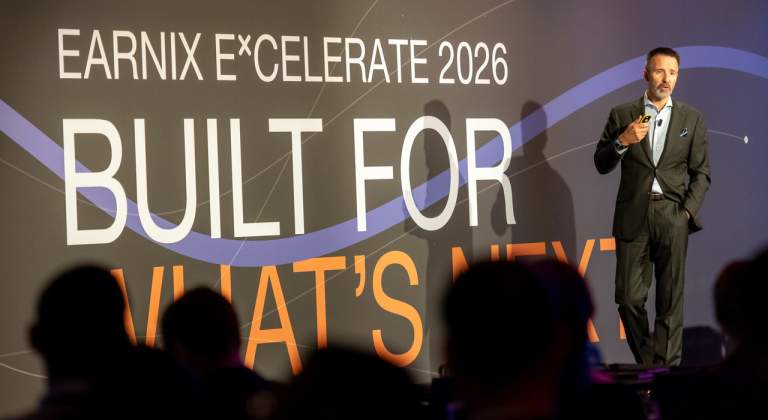
Earnix CEO Robin Gilthorpe opened Excelerate London by examining the pressures reshaping insurance. Risk is becoming more difficult to predict, profitability and growth are harder to protect, and AI is introducing new capabilities into operating environments already managing legacy technology, fragmented workflows, and rising governance expectations.
These pressures converge at the point of decision.
Pricing, underwriting, customer engagement, claims, and portfolio decisions may sit in different parts of the organisation, but they ultimately influence many of the same outcomes: growth, profitability, risk, and customer value. The challenge is that the systems, workflows, and intelligence supporting those decisions have often remained fragmented. Information from one part of the business may not reach another quickly enough to shape what happens next, making it harder to respond cohesively as conditions change.
Gilthorpe described the result as an “agility crisis,” a widening gap between understanding what is changing and responding with the speed, precision, and control the business requires.
Closing that gap requires more than adding AI to existing processes. It requires orchestrating the data, models, business rules, AI, workflows, and human expertise surrounding each decision, while recognising that decisions across the insurance journey are interconnected.
That is the opportunity behind intelligent decisioning. Earnix AIOS, the AI Orchestration System purpose-built for insurance, provides the environment for bringing data, models, business rules, AI, workflows, governance, and human expertise together around those decisions within insurers’ existing technology environments.
Bringing Agentic AI Into Insurance Decisions
Excelerate London also marked the introduction of Agent Hub, part of Earnix AIOS and a major step in bringing that vision to life.
Agent Hub brings insurance-specific AI agents and apps directly into Earnix pricing and rating, underwriting, and customer engagement solutions. Instead of operating as standalone assistants, agents can work within existing insurance workflows and technology environments, drawing on the data, models, and business context surrounding the decision while maintaining defined permissions, traceability, and human oversight.
Agents are one part of a broader intelligence environment. Predictive models, generative AI, agentic AI, business rules, and human expertise each bring different strengths. The opportunity is to bring the right combination to the decision at hand, rather than treating any single form of AI as the answer to every problem.
Throughout Excelerate, attendees saw examples of agents designed for specific insurance tasks, including helping teams connect model features to trusted data variables, providing real-time product expertise, and giving customers personalised explanations of their premiums.
The significance goes beyond automating individual tasks. Agentic AI can increasingly interpret information, coordinate work, initiate actions, and move decisions forward. That creates an opportunity to increase practitioner capacity and shorten the distance between intelligence and action, but it also raises the standard for governance.
As Robin noted in announcing Agent Hub, the opportunity is not simply to deploy more agents. It is to turn agentic AI into better business performance while remaining firmly in control.
From Technology to Business Performance
That focus on execution carried through the broader Excelerate agenda.
Be’eri Mart, Earnix Chief Product and Technology Officer, explored what it takes to move AI beyond promising pilots and isolated innovations into repeatable business results. Sessions throughout both days then showed what that transition can look like across the insurance journey.
Aviva shared its work to transform pricing across multiple lines of business, while iA Assurance examined how pricing and legal teams worked together under a regulatory deadline, using disciplined governance and pricing agility to move faster while keeping compliance embedded in the process.
Other discussions broadened the conversation across the insurance business. Hiscox explored how trusted data can support faster, more informed pricing and underwriting decisions, while a customer panel featuring UNIQA, Vitality Health, and INSHUR focused on what it takes to expand AI responsibly — from explainability and governance to human oversight and trust.
The same principle was evident in discussions about commercial underwriting and emerging risk. As technology gives insurers greater analytical and predictive capability, experienced judgement remains critical to decisions involving complex risks, appetite, and capacity. And as exposures such as climate, cyber, and AI evolve, insurers increasingly need to combine historical experience with new sources of intelligence, not simply to understand changing risk, but to decide how to prevent, mitigate, and respond to it.
Day Two moved the discussion from ambition into execution. Sessions explored how AIOS can orchestrate intelligence across decisions, how AI can strengthen modelling and monitoring, and how insurers can apply that intelligence across customer engagement, commercial underwriting, and portfolio management. Governance was therefore not a separate conversation from innovation, but a condition for putting AI into consequential decisions. As AI moves from analysis and recommendation toward taking action, discussions explored how permissions, explainability, traceability, monitoring, human oversight, and clear accountability can be designed into the way intelligence operates.
Together, the sessions reflected an important shift in the insurance AI conversation. The challenge is moving beyond individual models, applications, and experiments to create an environment where intelligence can consistently reach the decisions that determine business performance.
Built for What’s Next
Major Tim Peake’s Day Two keynote offered a different perspective on the same challenge, exploring decision-making, leadership, communication, and trust when carefully prepared plans encounter unexpected conditions.
Insurance faces its own version of that challenge every day.
Risk will continue to change. Markets will shift. New technologies will emerge, and regulatory expectations will evolve. Insurers cannot predict every change, but they can strengthen their ability to recognise it, decide how to respond, and put those decisions into action.
That is where intelligent decisioning, orchestration, and insurance-specific AI come together.
The next era of insurance will be shaped not simply by how much intelligence organisations have at their disposal, but by how effectively they can apply it to the interconnected decisions to turn that intelligence into decisions and actions that drive growth, profitability, risk, and customer outcomes.
Explore our event website, where we’ve shared all the sessions on demand, and contact us to continue the conversation.